Artificial intelligence is no longer a futuristic concept in veterinary medicine—it's a practical reality that's helping clinics work more efficiently today. From AI-powered diagnostic suggestions to hands-free documentation, these tools are designed to support (not replace) veterinary professionals, saving hours of administrative work while improving patient care.
This guide explores the AI tools available in modern veterinary practice management systems and how they can benefit your clinic.
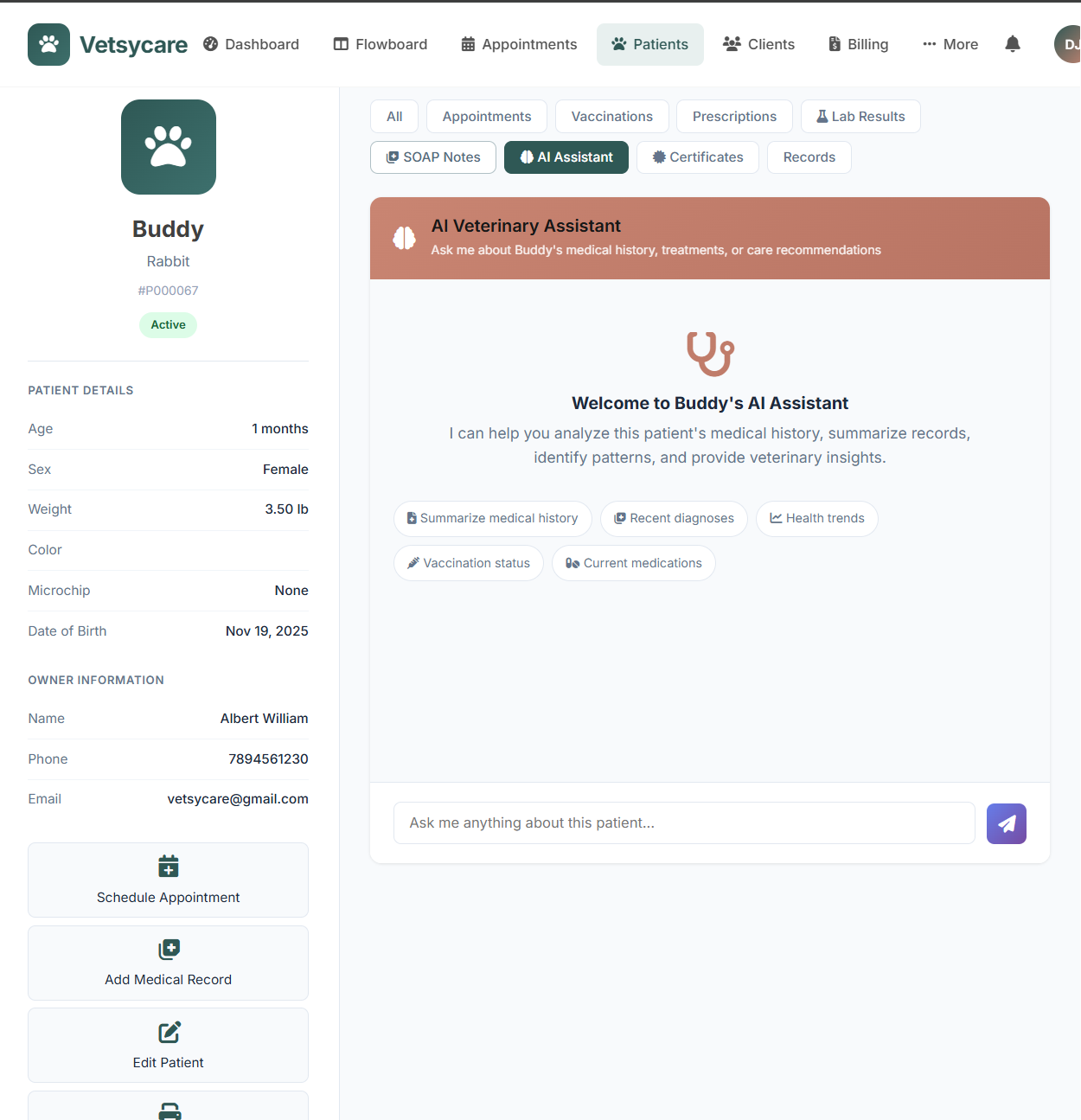
The AI Opportunity in Veterinary Practice
Veterinarians face a documentation paradox: thorough records are essential for patient care and legal protection, but writing them takes time away from patients. The average veterinarian spends 1-2 hours daily on documentation and administrative tasks.
AI tools address this by:
- Automating repetitive documentation tasks
- Providing decision support without replacing clinical judgment
- Catching potential errors before they reach patients
- Organizing information for faster retrieval
AI Diagnostic Assistant
An AI diagnostic assistant analyzes patient presentation data and suggests differential diagnoses for veterinary consideration.
How It Works
- You enter symptoms, history, and physical exam findings
- AI analyzes against patterns from veterinary literature and case data
- System generates ranked differential diagnoses with confidence scores
- You review, select, or modify based on your clinical judgment
What AI Considers
- Species and breed: Breed-specific disease predispositions
- Age: Age-related condition likelihood
- Presenting symptoms: Pattern matching with known presentations
- Physical exam findings: Objective data points
- Patient history: Previous conditions, medications, surgeries
Example Use Case
Input: 8-year-old Golden Retriever, presenting with increased thirst/urination, weight loss despite good appetite, lethargy
AI Suggestions:
- Diabetes mellitus (High confidence - 78%)
- Hyperadrenocorticism/Cushing's (Medium-High - 62%)
- Chronic kidney disease (Medium - 45%)
- Hyperthyroidism (Low - 15%)
Recommended diagnostics: CBC, comprehensive chemistry panel, urinalysis, urine culture
Benefits
- Reduce cognitive load: Quick reminder of differentials you might not immediately recall
- Training support: Helpful for new graduates building diagnostic experience
- Efficiency: Faster path to appropriate diagnostics
- Documentation: Easy to record your differential diagnosis reasoning
Drug Interaction Checking
AI-powered drug interaction checking provides real-time alerts when prescribing medications that may interact.
How It Works
- System knows patient's current medications
- When adding a new prescription, AI checks for interactions
- Alerts appear with severity level and clinical significance
- You decide whether to proceed, adjust, or choose an alternative
Interaction Severity Levels
| Severity | Meaning | Recommended Action |
|---|---|---|
| Severe | Life-threatening or significant harm possible | Avoid combination |
| Moderate | May worsen condition or require monitoring | Use with caution, monitor closely |
| Mild | Minor effect, usually not clinically significant | Be aware, proceed as indicated |
Example Alert
NSAIDs (Carprofen) + Corticosteroids (Prednisone)
Concurrent use significantly increases risk of gastrointestinal ulceration and bleeding. Consider alternative pain management or ensure adequate gastroprotection if combination is necessary.
Benefits
- Patient safety: Catch potentially harmful combinations before dispensing
- Time savings: No need to manually cross-reference each prescription
- Comprehensive: Checks against all current medications automatically
- Education: Provides context about why interactions matter
AI Voice Dictation
Voice dictation with AI processing transforms how veterinarians document patient visits.
How It Works
- Speak naturally during or after the examination
- AI transcribes speech with high accuracy (99%+ for veterinary terminology)
- Intelligent structuring organizes content into SOAP format
- Review, edit if needed, and finalize
Key Features
- Veterinary vocabulary: Recognizes drug names, conditions, breeds, anatomical terms
- Auto-formatting: Structures dictation into appropriate SOAP sections
- Hands-free: Dictate while examining, keeping focus on patient
- Speed: Speaking is 3-5x faster than typing for most people
What You Say vs. What Gets Documented
You say:
"Max is here for vomiting, owner says it's been three days, two to three times daily usually after eating. On exam temp is 101.8, heart rate 110, respiratory rate 24, weight 28.4 kilos down from last time. He's quiet but responsive, maybe 5 out of 9 body condition, mildly dehydrated with two second skin tenting. Abdomen is soft but he guards a bit when I palpate cranially, no masses. I'm thinking gastritis, could be dietary indiscretion, need to rule out foreign body and pancreatitis. Going to run a CBC chem and rads."
AI structures as:
S: Vomiting x 3 days, 2-3 times daily, typically post-prandial.
O: T: 101.8°F, HR: 110 bpm, RR: 24/min, Weight: 28.4 kg (decreased from previous). General: QAR, BCS 5/9, mild dehydration (skin tenting ~2 sec). Abdominal: Soft, guarding on cranial palpation, no masses palpated.
A: Acute gastritis. Differentials: dietary indiscretion, foreign body (r/o), pancreatitis (r/o).
P: Diagnostics: CBC, chemistry panel, abdominal radiographs.
Time Savings
- Average typing speed: 40 words per minute
- Average speaking speed: 125-150 words per minute
- Result: 3-4x faster documentation, typically saving 30-60 minutes per day
AI Treatment Plan Generation
AI can suggest evidence-based treatment protocols based on diagnosis and patient factors.
What It Provides
- Standard protocols: Treatment approaches based on veterinary guidelines
- Dosing calculations: Weight-based medication dosing
- Duration recommendations: Standard treatment lengths
- Monitoring parameters: What to check and when
- Client instructions: Pre-written home care guidance
Example
Diagnosis: Acute gastroenteritis, canine, 28 kg patient
AI Suggested Protocol:
- Anti-emetic: Maropitant (Cerenia) 2 mg/kg PO q24h x 4 days [56 mg = one 60mg tablet]
- Gastroprotectant: Famotidine 0.5 mg/kg PO q12h x 7 days [14 mg = one 20mg tablet halved]
- Fluid support: If dehydrated, SQ LRS 20-40 ml/kg
- Diet: NPO 12-24 hours, then bland diet (low-fat, easily digestible) small frequent meals x 3-5 days
- Recheck: If no improvement in 48-72 hours or worsening symptoms
You can accept, modify, or reject any suggestions based on your clinical assessment.
Practical Benefits for Your Practice
Time Savings
| AI Tool | Time Saved (Daily) | Annual Impact |
|---|---|---|
| Voice Dictation | 30-45 minutes | 125-185 hours |
| Diagnostic Assistant | 10-15 minutes | 40-60 hours |
| Treatment Plan Generation | 10-15 minutes | 40-60 hours |
| Total | 50-75 minutes | 200-300+ hours |
Quality Improvements
- More complete documentation: Easier to be thorough when dictating vs. typing
- Fewer missed interactions: Automated checking catches what humans might miss
- Consistent protocols: Standardized treatment approaches across the practice
- Reduced cognitive fatigue: Offload routine tasks to focus on complex decisions
Implementing AI in Your Practice
Ready to adopt AI tools? Here's a practical approach:
Start Small
Don't try to implement everything at once. Start with one tool (voice dictation is often the easiest entry point) and build from there.
Allow Learning Time
AI systems often improve with use as you learn to work with them effectively. Give yourself and your team 2-4 weeks to develop proficiency.
Verify Before Trusting
In the beginning, carefully review AI suggestions and outputs. Build confidence in the system's accuracy before relying on it heavily.
Provide Feedback
When AI gets something wrong, note it. Good systems allow you to correct and improve accuracy over time.
Train Your Team
Ensure everyone understands what AI tools do, their limitations, and how to use them effectively.
Experience AI-Powered Practice Management
VetSyCare includes AI Diagnostic Assistant, Drug Interaction Checking, Voice Dictation with SOAP formatting, and Treatment Plan Generation—all designed to save time while improving care quality.
Start Your Free TrialFrequently Asked Questions
Will AI replace veterinarians?
No. AI tools are designed to support veterinary professionals, not replace them. Clinical judgment, physical examination skills, client communication, and complex decision-making remain fundamentally human capabilities. AI handles routine documentation and provides decision support to make your work more efficient.
Is AI accurate enough to trust?
Modern AI tools have high accuracy rates, but they're not perfect. They should be used as support tools with human verification. Voice dictation accuracy exceeds 99% for standard vocabulary. Diagnostic suggestions should always be validated against your clinical findings.
What about patient data privacy?
Reputable AI-powered PIMS systems use enterprise-grade security and encryption. Data used for AI processing should be anonymized and protected. Always verify your vendor's data handling practices.
Do I need special training to use AI tools?
Most modern AI tools are designed for intuitive use. Basic onboarding (typically 1-2 hours) is usually sufficient. Proficiency develops naturally with daily use.
What if the AI makes a mistake?
You always have final authority over documentation and clinical decisions. Review AI outputs before finalizing. If errors occur, correct them and continue. Good systems learn from corrections to improve accuracy.